The Story of the
Lhomwe People
From the Rovuma River in eastern Mozambique to the hills of southern Malawi — a history of migration, resilience, and a culture reclaimed.
Explore the TimelineAt a Glance
A timeline, a founder's story, and the living traditions that continue to shape the identity of the Lhomwe people today.
Jump between sections using the navigation.
Meet Lewis Bandawe, the man who reclaimed the name.
Browse sixteen dialects spoken across the diaspora.
The Lhomwe People of Malawi
A chronological timeline, the story of the man who reclaimed the Lhomwe name, the traditions still practiced today, and the dialects that carry the language across the diaspora.
Historical Timeline
Key moments that shaped Lhomwe identity and presence in Malawi.
1300–1400
Early Presence in Malawi
The Lhomwe originated from eastern Mozambique and spread westwards, arriving in Mulanje (that included Phalombe) even before the Maravi people. Presence of Lhomwes in Malawi (Nyasaland) is reported to be as early as 1400. Linguistic analysis has documented a south-westerly movement out of the Rovuma River region as early as 1300 — though these early migrations were made up of single households, without any group leader, unlike other ethnic groups arriving at the time.
Late 19th Century
Migration, Trade & Colonisation
Large numbers of Lhomwe had migrated to Malawi before missionaries, white traders, and colonial administrators arrived in the latter part of the nineteenth century. To identify family members or clans, arrivals would deliberately cough at one another, followed by a clan name — Mbewe, Nkhoma, and others. British tea and coffee plantations offered employment, and many Lhomwe also worked as porters or mercenaries for the settlers.
1930s
Mass Influx from Mozambique
A large wave of Lhomwe crossed into Malawi in the 1930s, driven first by the slave trade and then by Portuguese forced-labour policy. Tens of thousands fled across the border — one of the largest population movements in the history of Southern Africa — and it would go on to reshape the demographic and cultural landscape of the region.
1943
Alhomwe Tribal Representative Association
Lewis Mataka Bandawe founded the Alhomwe Tribal Representative Association. Its first major act was petitioning the colonial government to ban the term "Anguru" in favour of "Lhomwe." Under pressure from the tone of letters published in the Nyasaland Times, the government agreed — a turning point in Lhomwe self-recognition.
1951
The Lhomwe Tribe Is Launched
The Lhomwe tribe was formally launched in 1951 at "Mikweyi" — now Migowi, in Phalombe — where the word Lhomwe was explained to mean peace and new beginning. The slogan "Alhomwe Alhomwe Noophiya!!" ("we are now settled, let's unite and move forward") was unveiled. Following this open-ground conference, the many groups that had entered Nyasaland from Mozambique became one tribe.
2007
The Mulhako wa Alhomwe Renaissance
Mulhako wa Alhomwe launched at Chonde, Mulanje — reviving a culture that had been fading for decades. It was founded by former President Professor Bingu wa Mutharika, with a vision of a vibrant, unified Alhomwe people living peacefully alongside other ethnic groups. A Lhomwe Heritage Centre now stands at Chonde, with a library and a planned language school.
Lewis Mataka Bandawe
1887 — Founder, Alhomwe Tribal Representative Association
“The despised ‘Anguru’ people needed a spokesman. Bandawe understood the system well enough to become one.”
Lewis Mataka Bandawe was born at Mulumbo in 1887. He attended the school founded there by John Grey Kufa, and in 1899 was sent by Kufa to Blantyre for further training. He became a teacher, and in 1913 returned to Mozambique to work at Mihecan Mission Station, near the town of Alto Moloque — remaining there until 1928, at times acting as head of the mission, and translating the New Testament into the Shirima dialect spoken in the district.
On his return to Blantyre, he broke from the mission and became a clerk and interpreter in the judicial department, eventually rising to deputy registrar. With deep experience of both Nyasaland and Mozambique, Bandawe was uniquely placed to become the spokesman for a people then mockingly dismissed by others as "Anguru" — a name used to belittle and marginalise them.
He understood the colonial policy of Indirect Rule, which favoured Mang'anja and Yao leadership in the Southern Region, and began to speak instead of a "Vast Country" east of Lake Chilwa — stretching from Yao territory in the north to Sena territory in the south — populated by the Lhomwe and their sub-tribes, all looking to the Namuli Hills as their ancestral home.
In 1943 he founded the Alhomwe Tribal Representative Association, whose first act was petitioning government to ban the word "Anguru" in favour of "Lhomwe." The petition succeeded. By 1951, at the Migowi open-ground conference, the many dialectal groups that had crossed from Mozambique were formally unified as one tribe — a struggle that began with one man's insistence on being named correctly.
Economic Occupation
The Lhomwe's major economic occupation was historically hunting. Today, most Lhomwe are small-scale farmers working customary land, cultivating maize, millet, sorghum, cassava, sweet potatoes, rice, and a variety of legumes — including Kalongonda.
Mulhako wa Alhomwe
Launched 2007 · Chonde, Mulanje
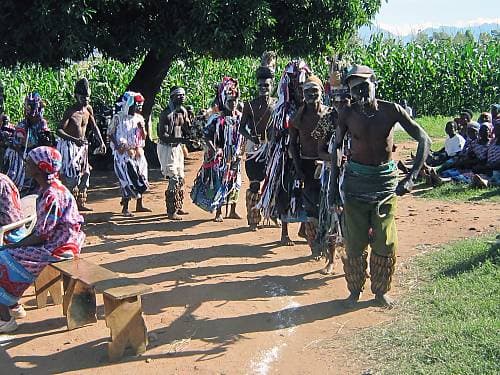
Founded by former President Professor Bingu wa Mutharika, Mulhako wa Alhomwe exists to expose children — and people from other tribes and countries — to Lhomwe customs: dance, drumming, storytelling, poetry, tribal history, arts and crafts. Its vision is simple: a vibrant, empowered, unified Alhomwe, coexisting peacefully with other ethnic groups while playing a meaningful part in Malawi's development.
Today, the Lhomwe Heritage Centre stands at Chonde — with a library open now, and a language school and gallery for tangible heritage planned for the future.
Dialects of the Lhomwe
Sixteen dialects, each shaped by geography and the communities that carried it — together preserving one shared identity.